Name: ____________________________ Period: ____
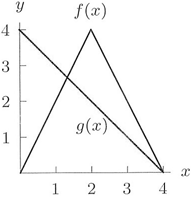
The functions f(x) and g(x) are defined in the below
Figure. [Figure 3.17, CSV 3.4, p.131, Questions 53−56.]
Make tables with x as rows and function values as columns.
Some quantities do not exist.
Chain rule formula for the derivative of a composite function: [f(g(x))]' = f
'(g(x))·g'(x).
1. Find:
f(0), f(1), f(2), f(3),f(4).
g(0), g(1), g(2), g(3),g(4).
f '(0), f '(1), f '(2), f '(3),f '(4).
g'(0), g'(1), g'(2), g'(3),g'(4).
2. Find:
g(f(0)),g(f(1)),g(f(2)),g(f(3)),g(f(4)).
3. Find:
g(g(0)),g(g(1)),g(g(2)),g(g(3)),g(g(4)).
4. Let m(x)=f(2x).
Find in two ways, using graph and chain rule formula:
m'(0), m'(0.5), m'(1), m'(1.5), m'(2), m'(3),m'(4).
5. Let k(x)=f(x/2).
Find:
k'(0), k'(1), k'(2), k'(3), k'(4), k'(6), k'(8).
6. Let r(x)=f(4x).
Find using chain rule formula:
r'(0), r'(0.25), r'(0.5), r'(1), r'(2),r'(4).
7. Let u(x)=g(f(x)). [Same as question 54.]
Find in two ways, using graph and chain rule formula:
u'(1),u'(2),u'(3).
8. Let w(x)=g(g(x)). [Same as question 56.]
Find:
w'(1),w'(2),w'(3).
This is http://teach.kralsite.com/. Latest update: Thursday December 04, 2008 07:17 PM -0800